
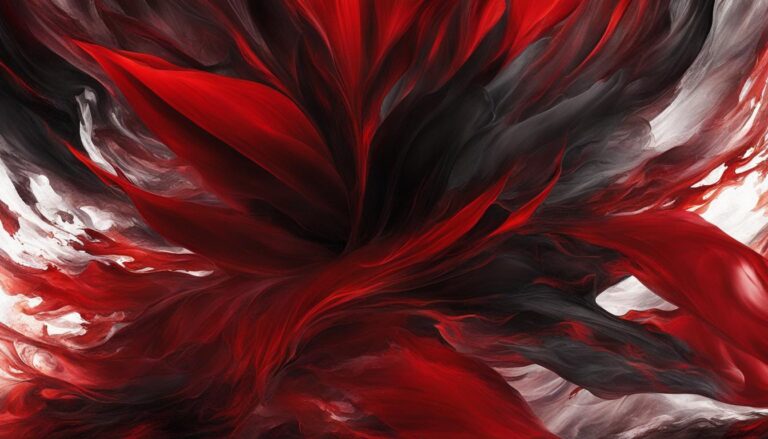
Red in a Dream: Meaning & Symbolism
Quick answer
Red in a dream is not a fixed symbol — it is an amplifier. Whatever it colors, it intensifies. The spiritual work is not to decode red itself but to ask: what was red, did the heat feel wanted or unwanted, and did I move toward it or away? Answer those three questions and the dream opens.
Had a different dream? Describe it and get a reading.
Interpret my dream →Why red resists a single meaning
Color in dreams behaves differently from color in waking life. Your sleeping mind does not reach for a symbol dictionary — it reaches for feeling. Red is the color your nervous system already associates with the body’s most urgent states: blood moving fast, heat rising, a signal that cannot be ignored. That physiological root is precisely why red shows up at opposite ends of the emotional spectrum — rage and romance, warning and celebration, injury and vitality — all at once.
This is also why the standard list (“red means passion, red means danger”) produces frustrating non-answers. Both are true. Neither helps you understand your dream.
The heat-source method
Think of red in a dream as a heat source — something radiating energy into the scene. Your job upon waking is to locate the source and describe your relationship to it. Three questions do the work:
- What, exactly, was red? A wound, a dress, a door, the whole sky, someone’s face, your own hands? The object matters as much as the color. Red attached to a person carries different freight than red attached to a landscape.
- Did the heat feel wanted or unwanted? Was the red warmth — the kind you lean into — or was it alarm, the kind that makes you want to step back? This single distinction cuts through most of the ambiguity.
- Did you move toward it or away from it? Dream behavior is rarely random. If you ran from the red, you may be avoiding something you recognize as intense. If you reached for it, you may be hungry for more of whatever it represents in your life.
Run those three steps before you reach for any broader interpretation. They give you a personal answer instead of a generic one.
Red object vs. red atmosphere
One distinction that changes everything: is red an object in an otherwise normal scene, or is red the atmosphere — the light, the sky, the whole emotional climate of the dream?
A red object (a coat, a rose, a car, a door) focuses the intensity on one specific thing. Your unconscious is flagging that thing. Pay attention to what it represents in your waking life — not the redness, but the thing itself now charged with urgency.
A red atmosphere — a room bathed in crimson, a sunset that bleeds across the whole dream — suggests a more pervasive emotional state. Something is coloring your entire inner world right now. That is usually a sign that the feeling has been running longer and deeper than you have acknowledged while awake.
What red actually looks like in practice
Blood and injury
Dreaming of blood — your own or someone else’s — is one of the most common red dreams and one of the most misread. The first instinct is fear. But in dream logic, blood is life force made visible. A wound that bleeds in a dream often signals not that something is broken beyond repair, but that something living has been cut — a relationship, a project, a part of yourself you have been neglecting.
Vignette: One dreamer watched her hands bleed while planting seeds in a garden. She woke certain something terrible was coming. In reflection she recognized she was pouring energy into a new business at personal cost — the image was accurate, not prophetic. The dream was not warning her to stop. It was showing her the cost and asking whether she considered it worth paying.
Blood dreams are not medical signals. If you are concerned about your health, consult a doctor — a dream cannot diagnose you.
Rage and the red face
When red appears on a person’s face — yours or someone else’s — it almost always signals anger that has not found its way out. The heat-source method is especially useful here. If the red-faced figure is a stranger, consider whether the anger belongs to you but has been projected outward. If it is someone you know, the question is whether unspoken conflict with that person has been building pressure.
Vignette: A man dreamed his father’s face turned red during a conversation that, in the dream, felt completely calm. He realized upon waking that he had been absorbing his father’s barely-concealed frustration for months without naming it. The dream gave him language: this relationship is running hot beneath the surface.
Romantic heat and desire
Red in a romantic context — a red dress, red lips, a red room, the color flooding in when someone touches you — is the nervous system marking desire. This kind of red almost always feels wanted in the dream. The spiritual question is not whether desire is good or bad but whether the dream is pointing to something you have been suppressing or something you are ready to act on.
If the red feels embarrassing to examine in the daylight, that is useful information too. Shame about a feeling is not the same as the feeling being wrong. Dreams rarely moralize.
Celebration and vitality
Red in festive contexts — a table set for a feast, lanterns at a celebration, someone dressed in red at a joyful gathering — carries the warmth of communal life. Many traditions use red to mark occasions of significance: weddings, new years, rites of passage. When this red appears in a dream it often surfaces at moments when the dreamer is either longing for belonging or on the threshold of a significant transition and the inner life is marking it before the outer life catches up.
Spiritual framing without false certainty
Across many spiritual traditions — Jungian psychology, Chinese cosmology, Vedic color symbolism, Sufi poetic imagery — red marks the place where life is most alive and therefore most at risk. It is the color of the heart, of fire, of survival instinct and the capacity to love. These frameworks are useful not because they are literally true but because they name the territory accurately: red shows up where something matters enough to generate heat.
What spiritual dream work cannot responsibly offer is prophecy. A red dream does not predict a fight, an accident, or a romance. It describes the emotional temperature of your inner life right now. That is genuinely useful. It is not the same as a forecast.
A practice for after you wake
When you wake from a dream that involved red, resist the urge to immediately look it up or tell someone else. Spend a few minutes with these steps first:
- Write down exactly what was red and one word for how the red felt (welcoming, alarming, exciting, sad, strange).
- Ask yourself: in my waking life right now, where is this feeling active? Name one specific situation, not a category.
- Identify one small, concrete action you could take today toward or in response to that heat source. Not a resolution — a gesture. Send the message, take the walk, have the conversation, set the boundary.
The goal is not to solve the dream. It is to let the dream’s energy move through you into something real rather than dissolving it by lunchtime.
Related guides
- Dream meanings hub
- What does the color yellow mean in a dream?
- What does a red car mean in a dream?
- Meaning of dreaming of a red snake
Honest limits
This is a method for reflection, not a diagnosis. Dreams are not medical, financial, or crisis guidance. If recurring nightmares, disturbing imagery, or sleep disruption are affecting your daily life, speak with a qualified professional — symbolic reflection can sit alongside that care, but it does not replace it. You remain the best expert on what your own dreams mean.
For more ways to work with your dreams, start at the dream meanings hub. Learn more about who we are on our About page.
Author

Before you read a fixed meaning, ask:
What happened — the central image or event, in one plain sentence.
How it happened — calm or violent, easy or forced, sudden or slow.
Who was watching — alone, one person, or a crowd.
Those three usually matter more than the symbol name alone.
What do the common variations mean?
Details change the reading. As you go through the guide, notice how the dream happened, how it felt, and who was there — those are the “variations” that matter most.
What this dream is not
It is not a reliable omen predicting death, diagnosis, or a fixed fate. Symbolic reading sits beside medical and practical care — it does not replace either. If something in waking life needs action, take that action directly.
Frequently asked questions
Is this dream a bad omen?
No. Common anxiety and transition dreams are not evidence of literal danger. Treat them as invitations to notice pressure, change, or emotion — not as predictions.
Why do I keep having this dream?
Recurring dreams usually mean the underlying situation is still active. If they disturb sleep often enough to worry you, mention the pattern to a doctor or therapist.
Does every detail have a fixed meaning?
No. Shared symbolism is a starting map. The feeling in the dream and the life around it decide which reading fits.
Explore the next dream


Dreams are not medical, legal, or financial advice. The Dream Symbolist offers symbolic interpretation to support reflection, not diagnosis.