
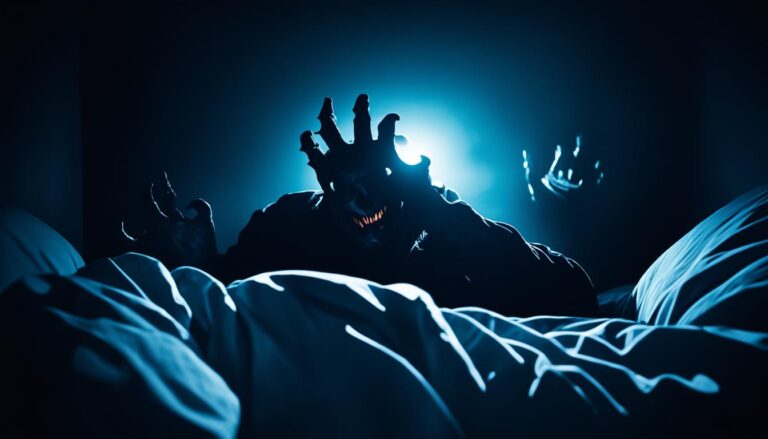
Dreams About Demons: Meaning & Symbolism
Quick answer
Dreams about demons almost always point inward. The demon typically represents a part of yourself you fear, an external pressure you feel powerless against, or a habit or relationship dynamic that feels controlling. Most people who have this dream are going through a period of real stress, guilt, or suppressed anger.
Had a different dream? Describe it and get a reading.
Interpret my dream →Why this dream sticks
Demonic imagery hits the brain’s threat-detection system hard. The visual is vivid, the emotional charge is high, and the dread lingers into waking hours in a way that milder anxiety dreams don’t — which is part of why the dream feels more significant than a standard nightmare. It often is.
From a psychological standpoint, the demon archetype has been used across nearly every culture to externalize internal conflict. What Carl Jung called the Shadow — the parts of yourself you’ve rejected, hidden, or refused to look at — frequently shows up in dreams as something dark, threatening, and non-human. The more you’ve suppressed something, the more monstrous it tends to appear.
Recurring demon dreams are worth paying attention to. The dream is usually trying to surface something that waking life keeps pushing down. If you want a broader framework for reading recurring patterns, the interpret guide covers how to track and decode themes over time.
Common variations and what they reflect
| Dream variation | What it commonly reflects |
|---|---|
| Being chased by a demon | Avoidance of something in waking life — a conversation, decision, or emotion you keep running from rather than addressing |
| Being possessed by a demon | A feeling of losing control over your behavior, a situation, or an impulse (anger, addiction, obsessive thinking) that seems to act through you |
| Fighting a demon and winning | Active psychological work paying off — you are processing and integrating the conflict rather than running from it |
| Fighting a demon and losing | Feeling overwhelmed by a pressure or habit; a signal to seek outside support rather than going it alone |
| A demon that looks like someone you know | Unresolved tension or fear connected to that person — possibly boundary violations, manipulation, or unspoken resentment |
| A demon in your home or bedroom | Feeling unsafe in a space that should be private and restful; often tied to relationship conflict, family stress, or a sense that your private self is under threat |
| A demon speaking to you | Pay attention to the words. The demon’s voice is often your own inner critic or internalized pressure in exaggerated form |
| A child-demon or small demon | A minor but persistent worry or guilt — something you’re treating as trivial that actually needs acknowledgment |
What this dream is not
It is not a prophecy, a supernatural visitation, or evidence that something is spiritually or mentally wrong with you. Having this dream does not mean you are “dark” or that your subconscious is broken. It means your mind is doing exactly what minds do — processing conflict through symbol and story.
It is also not something to ignore by default. If the dream is recurring, escalating in intensity, or leaving you anxious throughout the day, treat that the same way you’d treat any other persistent source of stress. The content is symbolic; the emotional signal is real.
For comparison, falling dreams follow a similar pattern — alarming imagery, benign psychological source — and respond to the same kind of reflective approach.
A short practice
Within a few minutes of waking, before details fade, write down three things: what the demon looked like, what you felt (not just “scared” — more specific, like “trapped” or “ashamed”), and what you were doing or trying to do in the dream. Then ask: where in my waking life does that feeling show up right now?
You don’t need a complete answer. The practice is to close the gap between the symbol and the actual stress it points at. Most people find that once they can name the real-world source, the dream either changes character or stops recurring.
If you want a structured way to work through what you write down, the dream interpretation guide walks through a repeatable method for moving from image to meaning.
Frequently asked questions
Does dreaming about demons mean I have repressed trauma?
Not necessarily. Demon dreams correlate most strongly with current stress, guilt, or a sense of being controlled — none of which require a traumatic origin. That said, if the dreams are severe, fragmented, or tied to specific disturbing memories, that’s worth exploring with a therapist. The dream alone isn’t a diagnosis either way.
Why do I keep dreaming about the same demon over and over?
Recurring demon dreams usually mean the underlying conflict hasn’t been addressed. The repetition is the mind’s way of keeping the issue in view. When the real-world stress shifts or you genuinely process the emotion it represents, the recurrence typically fades. See also: recurring dreams guide for patterns common to this type.
Is there a difference between dreaming of a demon versus a monster or dark figure?
The psychological reading overlaps significantly — all three tend to represent the Shadow, suppressed emotion, or external threat. The distinction is in the specific connotation your mind attached to the image. A demon often carries moral weight (guilt, temptation, judgment), while a formless dark figure tends to represent pure fear or the unknown. What matters most isn’t the label but the emotional texture of the dream and where that feeling maps onto your waking life.
This article is for informational purposes only and is not a substitute for professional mental health advice.
Author

Explore the next dream


Dreams are not medical, legal, or financial advice. The Dream Symbolist offers symbolic interpretation to support reflection, not diagnosis.