
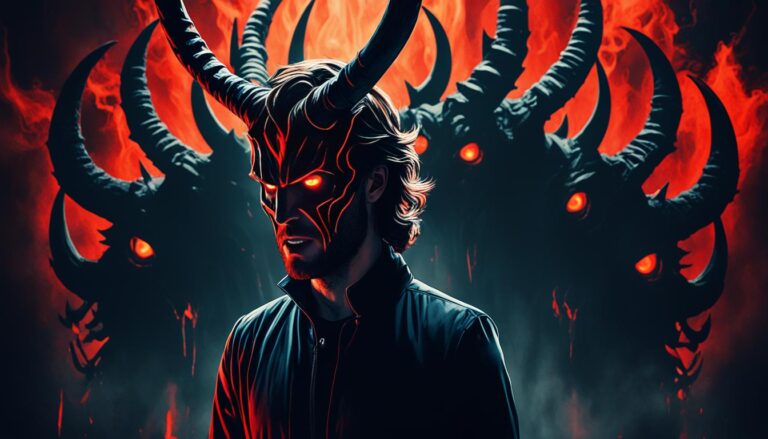
What Does It Mean to Dream About the Devil?
Quick answer
Dreaming about the devil most often signals an internal conflict — a part of yourself you've been taught to suppress, a temptation you're wrestling with, or a fear of losing control. The figure rarely predicts evil or spiritual danger. It is your mind externalizing something that feels forbidden, powerful, or shameful so you can face it directly.
Had a different dream? Describe it and get a reading.
Interpret my dream →Why this dream sticks
The devil is one of the most culturally saturated symbols a dreaming mind can reach for. Whether you are religious or not, you grew up surrounded by imagery linking this figure to guilt, desire, deception, and raw power. That saturation is precisely why your unconscious chooses it — when something in waking life feels morally charged or hard to name, the psyche casts the heaviest possible actor in the role.
Devil dreams linger because they trigger the body’s stress response. You may wake with a racing heart, and that physical imprint strengthens the memory trace. The dream sticks not because it was prophetic, but because it was physiologically intense. Understanding that mechanism already reduces its grip.
Common waking-life triggers include a decision that conflicts with your values, a relationship where you feel manipulated, chronic guilt over something you have or haven’t done, or a period of high stress in which you feel you are “making a deal” — trading your wellbeing for security, approval, or success. This dream often appears alongside anxiety dreams during major life transitions.
What the common variations mean
| Variation | What it commonly reflects |
|---|---|
| The devil is chasing you | Avoidance of something you know you need to confront — an addiction, a relationship pattern, or a truth you keep outrunning |
| You are talking calmly with the devil | Negotiation with a difficult part of yourself; this can be a healthy sign that you are integrating rather than suppressing a troubling impulse |
| You make a deal or sign a contract | Waking-life anxiety about compromise — a job offer, a relationship, or a financial decision that feels like it costs you something essential |
| The devil wears a familiar face (boss, parent, partner) | You associate that person with control, manipulation, or moral pressure; the dream is processing power dynamics in that relationship |
| You become the devil | Guilt about your own anger, cruelty, or desires; the mind is forcing you to own a shadow quality rather than project it outward |
| You defeat or rebuke the devil | A positive resolution signal — you are working through a fear or temptation and arriving at a sense of agency |
| The devil is laughing at you | Feelings of humiliation or shame; often connected to imposter syndrome or a secret you fear being revealed |
| You are in hell with the devil | A sense of being trapped in an inescapable situation — a job, a living arrangement, a cycle of behavior — rather than a literal fear of damnation |
For more on how dark figures work symbolically, see the guide to shadow figures in dreams and the broader overview at how to interpret your dreams.
What this dream is not
It is not a spiritual verdict on your character. Dreams draw on cultural imagery the way a novelist draws on archetypes — for emotional leverage, not literal truth. Dreaming about the devil does not mean you are evil, cursed, or spiritually compromised.
It is not a premonition. The sleeping brain simulates threats as a way of rehearsing emotional responses. A devil in a dream is closer to a stress-test than a forecast.
It is not evidence that you are secretly a bad person. Often the people who dream about the devil most vividly have a highly developed moral conscience — the dream is a byproduct of taking ethics seriously, not proof of failure. The absence of moral conflict tends to produce more peaceful dreamscapes.
It is not a reason to panic on waking. The intensity of the imagery is a feature of the dream mechanism, not a measure of the severity of what it represents. See what recurring nightmares mean if this dream returns frequently.
A short practice
Within a few minutes of waking, before the imagery fades, write down two things: what the devil wanted from you, and what you refused or feared to give. Then ask yourself where in waking life those same dynamics appear. You are not looking for a dramatic revelation — you are looking for the ordinary tension the dream dressed in extraordinary clothes.
If you find a clear match, name it plainly in your journal: “I am anxious about X” or “I have been avoiding Y.” Naming it moves the emotional charge from the image to the actual subject, where your attention can do real work. The prompts at our interpretation guide can take this further.
Frequently asked questions
Is dreaming about the devil a sign of religious significance?
For people with a religious background, this dream may carry additional weight, and that is worth taking seriously on a personal level. Dream researchers find, however, that the figure appears across secular and religious dreamers at similar rates during periods of moral conflict or stress — the dream is engaging the symbol, not necessarily delivering a theological message. If the spiritual dimension feels significant, bringing it to a trusted religious counselor alongside your own reflection is entirely reasonable; the two approaches are not mutually exclusive.
Why does this dream keep coming back?
Recurring devil dreams almost always point to an unresolved waking situation — something you are circling rather than addressing. The repetition is not an escalating warning; it is the brain re-running an unsolved problem. The pattern typically breaks when you take concrete action on whatever the dream is pointing toward: a conversation you have been avoiding, a habit you have been tolerating, a boundary you have not set. Journaling the differences between each occurrence often reveals how your relationship to the underlying issue is shifting, even when the dream feels identical.
Does this dream mean something different for children?
In children, devil imagery is usually straightforward fear processing — exposure to a scary story, film, or religious teaching that the child’s mind is filing away. It rarely carries the symbolic weight it holds in adult dreams. Discuss the dream in calm, curious terms (“what happened, and how did it end?”) rather than treating it as symbolically loaded. If nightmares are frequent and causing distress, a child psychologist can offer age-appropriate support. Nothing here is a substitute for professional advice.
Author

Before you read a fixed meaning, ask:
What happened — the central image or event, in one plain sentence.
How it happened — calm or violent, easy or forced, sudden or slow.
Who was watching — alone, one person, or a crowd.
Those three usually matter more than the symbol name alone.
Meanings reflect widely shared symbolism; your own context comes first.
Explore the next dream

Dreams are not medical, legal, or financial advice. The Dream Symbolist offers symbolic interpretation to support reflection, not diagnosis.