
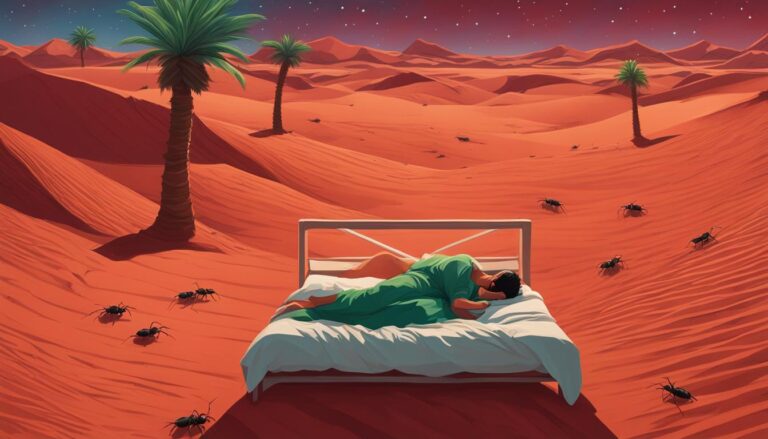
Dreaming of Ants: Symbolism and Meanings
Quick answer
Dreaming of ants almost always points to work, effort, and collective pressure. Ants represent coordinated labor, patience, and the feeling that something small is accumulating into something significant — for better or worse. The emotional tone of the dream tells you whether your mind sees that accumulation as progress or overwhelm.
Had a different dream? Describe it and get a reading.
Interpret my dream →Why this dream sticks
Ants are rarely neutral in dreams. They trigger a visceral response — the crawling sensation, the sheer number, the sense of organized purpose happening just outside your control. Your brain reaches for ants when it is processing themes it cannot reduce to a single image: collective pressure, incremental work, something minor that has grown too large to ignore, or the uneasy feeling that you are one small part of a vast system.
The image carries a tension between admiration and discomfort. Ants are symbols of extraordinary discipline, yet most dreamers wake from ant dreams feeling unsettled rather than inspired. That gap — between the ants’ competence and your unease — is usually where the real meaning lives. For a broader framework on reading this kind of dual-valence imagery, see our guide to how to interpret dream symbols.
Common variations and what they reflect
| Variation | What it tends to reflect |
|---|---|
| Ants crawling on your body | Small stressors accumulating physically — often linked to burnout or the feeling that minor obligations are taking over your attention |
| Ants in your home or bed | Something you considered manageable has entered your private life; a work or social problem is bleeding into personal boundaries |
| Being bitten by ants | Minor irritations or criticisms you have been dismissing are now causing real discomfort; the dream surfaces something you have been tolerating too long |
| Killing ants | An active desire to eliminate a source of annoyance or end a repetitive obligation; sometimes reflects guilt about cutting off small but consistent responsibilities |
| A single giant ant | One specific responsibility, person, or task has grown disproportionately large in your mental landscape; the scale distortion mirrors internal magnification |
| Watching ants work from a distance | Detachment from your own routines; feeling like an observer of your own labor — common during transitions or recovery from exhaustion |
| Ants carrying food or objects | Effort that feels purposeful even if slow; this variation is more positive and often appears when a long project is quietly progressing |
| Ant colony destroyed or flooded | Fear of disruption to a carefully built system — a team, a routine, a business — that you have invested significant effort maintaining |
What this dream is not
Dreaming of ants is not a prediction of infestation, illness, or bad luck, despite older folk interpretations. It is also not simply about “hard work” in a motivational sense — if the dream felt threatening, that reading misses the point entirely.
Ant dreams are almost never about the ants themselves. They are about scale and accumulation: the feeling that something small has grown into something that demands attention. Interpreting the ants as literal insects rather than as a metaphor for what is multiplying in your waking life leads most people away from what the dream is actually processing.
This dream is also not a sign that you are lazy or disorganized. It tends to appear more frequently in highly conscientious people — those who notice when small things pile up precisely because they care about managing them well. You can explore related patterns in our guide to dreaming about work and overwhelm.
A short practice
When you wake from an ant dream, spend sixty seconds with one question: What in my life right now feels like it is multiplying faster than I can address it? Write down whatever surfaces without editing. You are not looking for a clever answer — you are looking for the thing you already know but have been too busy to name. That is almost always what the dream came to surface. Once you have named it, return to the broader dream library to see whether related symbols appeared alongside the ants.
FAQ
What does it mean when ants are crawling inside your mouth or ears?
This variation tends to reflect anxiety about what you are taking in or allowing to influence you — words, information, or other people’s problems that feel invasive. The specific body part matters: mouth suggests something about communication or consumption; ears suggest something about what you are being asked to absorb. Both point to a boundary that feels compromised.
Is dreaming of red ants different from dreaming of black ants?
For most dreamers, yes — color carries emotional weight even when the dream does not make it explicit. Red ants tend to accompany sharper urgency, irritation, or pain. Black ants are more often associated with steady, relentless labor without immediate threat. That said, the action in the dream and your emotional response will always tell you more than the color alone.
I keep having this dream repeatedly — does that change the meaning?
Recurring ant dreams signal something unresolved. A single ant dream is often a passing response to temporary stress. A recurring one suggests that whatever the ants represent — accumulated pressure, a neglected obligation, a boundary issue — has not been meaningfully addressed. The repetition is not an intensification of the message; it is the same message asking to be taken seriously. See our guide to why dreams repeat and what to do about it for a practical approach.
This content is for reflective and educational purposes only and does not constitute medical or psychological advice. If recurring dreams are causing distress, consider speaking with a qualified mental health professional.
Author

Before you read a fixed meaning, ask:
What happened — the central image or event, in one plain sentence.
How it happened — calm or violent, easy or forced, sudden or slow.
Who was watching — alone, one person, or a crowd.
Those three usually matter more than the symbol name alone.
Meanings reflect widely shared symbolism; your own context comes first.
Explore the next dream



Dreams are not medical, legal, or financial advice. The Dream Symbolist offers symbolic interpretation to support reflection, not diagnosis.